Featured Post

Free Books - Index

Reading remains a gateway to learning and personal development, making the study of books indispensable in contemporary society. “Are the ...

Showing posts with label Moderation. Show all posts

POST-FORMATIVE DEVELOPMENTS IN ISLAM - By Fazlur Rahman


POST-FORMATIVE  DEVELOPMENTS  IN  ISLAM
Extremism to Pacifism 

It took time, however, for the absolutely pacifistic attitudes to harden.

At the time of the downfall of the Umayyad and the establishment of the 'Abbasids, the state of affairs was naturally still very liquid. Ibn al-Muqafa' (second quarter of the second century) complains that Muslims largely suffer from political extremism, one party contending that the political authority must be upset if it disobeys God or, rather, if it seeks to implement what constitutes disobedience to God, while the other party contends that the political authority must be placed by definition, as it were, beyond criticism, Ibn al-Muqafa' roundly dismisses the second group. With the first group he agrees that:

"there is no obedience (to the ruler) in disobedience of God," but he pointedly asks, if anybody is to be obeyed in righteousness, including the political authority, and if everybody is to be disobeyed, including the political authority, in what is deemed to be not righteousness, then what is the difference between the. Political authority and non-authority? How can, therefore, any political authority, worthy of the name, survive ?

Ibn al-Muqafa', therefore, suggests that while the dictum itself is correct, it is used as a camouflage for sedition and rebellion and, further, that whatever any particular group thinks to be the correct interpretation of the obedience or disobedience to God, it seeks to impose it on others by attempting to seize the political machinery.

It is to be remarked that Ibn al-Muqafa', while stating the view of both political extremes, does not refer to any Hadith or even alleged Hadith, either on the side of rebellions or absolute pacifism. And, indeed, no such Hadith is contained either in the Muwatta of Malik or the Athar of Abu Yusuf two eminent men of the second century. Ibn al-Muqafa certainly assumes that the state stands under the moral norms of Islam, but he insists that, in judging whether a particular state is so conforming or not, all contending groups must exercise that robust, healthy and constructive common sense which Islam did so much to inculcate and that, above all, the integrity of the Community and the stability of the state must never be lost sight of. We do not deny that pacifist Hadith was there: indeed, our analysis of the political Hadith in the last chapter has clearly shown that this Hadith was proved by Kharijism. What we are saying is that neither Ibn al-Muqafa' nor Malik nor yet Abu Yusuf makes any reference to such Hadith.

But the collectors of Hadith during the third Century zealously collected pacifist Hadith and, at the political level, pacifism henceforward is permanently erected into the dogmatic structure of Islam. A Muslim, from now on, does not possess the right of political resistance—that is to say, not only actually, but  even formally and theoretically. Many students of Muslim political history and theory—both Westerners and Muslim Modernists—have postulated an increasing influence on Islam of old Iranian ideas of kingship, where kings were regarded as sacred and inviolate. This story does not seem true. It is true that the political authority was vested with a quasi-inviolate character and later also expressions like "the shadow of God" are used, even by the orthodox—e.g., by Ibn Taymiyah.  But when the orthodoxy contends that "even an unjust ruler ought to be obeyed" and that:
"the Sultan is the shadow of God," we get the apparently strange result that "even an unjust ruler is the shadow of God".
Since by no stretch of imagination can this extreme construction be literally attributed to orthodoxy—least of all to a man like Ibn Taymiyah, the only meaning we can attach to the phrase "shadow of God" is that of a rallying point and a guarantee for security. And when we look at the earlier insistence of the orthodoxy, couched in Hadith form,  to keep to the majority of the Muslims and their political authority," the meaning becomes absolutely clear. No metaphysical implications, therefore, of the Old Iranian or other equivalent doctrine of ruler ship may be read into this dictum.
However, a closer reflection will reveal that a total conformism and pacifism, no matter through what noble purpose motivated, is completely self-defeating, for it inculcates political passivity and indifference and, subsequently, a fatal sense of suspicion against the government. And this is exactly what happened in Islam. If the maintenance of the solidarity of the Community was an overall objective.


* * * * * * * * * * * * * * * * * * *
Humanity, Religion, Culture, Science, Peace
Peace Forum Network
Books, Articles, Magazines,  Videos
Overall crossed 2 Million visits/hits
* * * * * * * * * * * * * * * * * * *
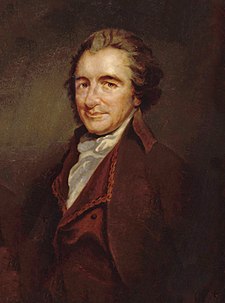
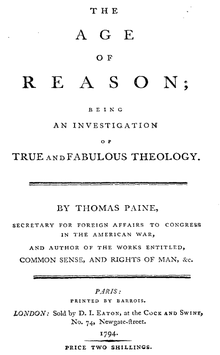
Age of Reason

Thomas Paine rev1.jpg

Theist, Deist, Atheist, Agnostic:

A theist believes there is a God who made and governs all creation; but does not believe in the doctrine of the Trinity, nor in a divine revelation.

A deist believes there is a God who created all things, but does not believe in His superintendence and government. He thinks the Creator implanted in all things certain immutable laws, called the Laws of Nature, which act per se, as a watch acts without the supervision of its maker. Like the theist, he does not believe in the doctrine of the Trinity, nor in a divine revelation.

The atheist disbelieves even the existence of a God. He thinks matter is eternal, and what we call “creation” is the result of natural laws.

The agnostic believes only what is knowable. He rejects revelation and the doctrine of the Trinity as “past human understanding.” He is neither theist, deist, nor atheist, as all these are past understanding.
~~~~~~~~~~~~~~~~~~~~~~~~~~~~~~~~~

The Age of Reason; Being an Investigation of True and Fabulous Theology is a deistic pamphlet, written by eighteenth-century British radical and American revolutionary Thomas Paine, that criticizes institutionalized religion and challenges the legitimacy of the Bible, the central sacred text of Christianity. Published in three parts in 1794, 1795, and 1807, it was a bestseller in the United States, where it caused a short-lived deistic revival. British audiences, however, fearing increased political radicalism as a result of the French Revolution, received it with more hostility. The Age of Reason presents common deistic arguments; for example, it highlights what Paine saw as corruption of the Christian Church and criticizes its efforts to acquire political power.

Thomas Paine (1737-1809) -- writer and revolutionary -- best known for his writings supporting American independence, was indicted for treason in England in 1792 for his work The Rights of Man, defending the French Revolution. More than one English publisher was also prosecuted for printing The Age of Reason, where Paine argues for Deism [Deism; combines a rejection of revelation and authority as a source of religious knowledge with the conclusion that reason and observation of the natural world are sufficient to determine the existence of a single creator of the universe] and against Christianity and Atheism.

Thomas Paine wrote the populist pamphlet, Common Sense, a clarion call for American independence and democracy. Driven by desire for freedom and justice, Paine's thinking reflected French and English writers like Rousseau, Burke, Locke, others in the "philosophy" movement, today called The Enlightenment.

In defense of the French Revolution and as a response to Burke, who had promptly condemned the French rebellion, Paine wrote and published  The Right of Man, part I appeared in early 1791, part II in February 1792.

Guided by his ideals more than the facts of "Madame Guillotine" and "The Terror" under Robspierre, Paine declared that governments exist to guard the natural rights of the individuals unable to ensure their rights without government's help. Four key rights are liberty, property, security, and resistance to oppression. In Part I, he argued for a republic governed under a constitution with a bill of rights, elected leaders serving limited terms, and a judiciary accountable to the general public. He called for equal suffrage for all men, (a true fellow of his times, dear women, sorry) and the end of social divisions by virtue of birth or rank or economics or religion. In Part II, Paine suggested social legislation to remove class inequities.

Paine's fervent hope was that Rights of Man would inspire in England the same revolutionary thirst for independence from monarchy as Common Sense inspired in America. Instead, despite selling about 200,000 copies by 1793, the pamphlet was suppressed by the government of William Pitt, who was unable to get his hands on Paine (still a British citizen), since Paine was safe in France. Pitt had Paine tried in absentia before the loyalists, convicting Paine of treason. England outlawed its native son in December 1792.

Paine was intrigued by the philosophies, the French social thinkers and encyclopedia creators who upheld scientific reasoning over irrational religious dogma, who posited that the mind is great, capable of knowing anything in time with diligent research, who saw the cosmos as the creation of one rational God who set the universe in motion with natural laws at work, like winding the precision clockwork, then turning humanity loose to govern ourselves by becoming educated enough to exercise our free will with self restraint within democratic laws. These thinkers called themselves "deists." Defined by Websters as "One who believes in the existence of a God or supreme being but denies revealed religion, basing his belief on the light of nature and reason."

Paine completed and published his critique of religion, The Age of Reason, with Part I in 1794 and Part II in 1796. "I believe in one God, and no more," he begins, "and I hope for happiness beyond this life."

Paine was a deist, not an atheist.The Age of Reason profers his metaphysical beliefs. He saw God as first cause and designer of the universe. God is knowable through the sciences and mathematics, through use of reason and natural intelligence. (Experiencing God through his heart or transcendent spirit also concerned Paine, but as a man of the mind, certainty of God had to came through his brain.) Christians do not try to know God in a reasonable way, he wrote. They rely upon a Bible, riddled with inconsistencies, subject to interpretation, therefore fallible. He compared the mythology of the Trinity with the paternity of Zeus, still a provocative analogy. Having dispensed with Christianity, Paine spoke again about his deist God as the power and wisdom anyone can witness, evidenced "in the immensity of the creation, ...in the unchangeable order by which the incomprehensible is governed."

Thomas Paine died at age 70 in New York on 8 June 1809. He did not expect a Christian burial in sacred ground after The Age of Reason. So stories about deathbed repentance likely are propaganda. Paine was buried in a corner of his new Rochelle farm. A decade later in 1819, one of Paine's harshest critics during the Nineties, William Cobbett, apparently moved to atone for his attacks, had Paine's bones dug up and transported to England for re-burial under a patriotic monument Cobbett planned to build. Cobbett died in 1835 with the memorial never erected. His English probate court assigned the old bones to a receiver. The fate of Paine's mortal remains today remains a mystery.
~~~~~~~~~~~~~~~~~~~~~~~~~~~~~~~~~~~~~~~
The Age of Reason
By  Thomas Paine
Table of Contents

Chapter I - The author's profession of faith
Chapter II - Of missions and revelations 
Chapter III - Concerning the character of Jesus Christ, and his history 
Chapter IV - Of  the bases of Christianity
Chapter V - Examination in detail of the preceding bases 
Chapter VI - Of  the true theology
Chapter VII - Examination Of The Old Testament
Chapter VIII - Of  the New Testament
Chapter IX - In what the true revelation consists 
Chapter X - Concerning God, and the lights cast on his existence and attributes by the Bible
Chapter XI - Of  the theology of the Christians; and the true theology 
Chapter XII - The Effects Of Christianism On Education; Proposed Reforms
Chapter XIII - Comparison of Christianism with the religious ideas inspired by nature
Chapter XIV - System of  the universe 
Chapter XV - Advantages of the existence of many worlds in each solar system
Chapter XVI - Applications of  the preceding to the system of  the Christians
Chapter XVII - Of  the means employed in all time, and almost universally, to deceive the peoples
Recapitulation
Source: http://www.ghazali.net/book9/Table_of_Contents/table_of_contents.html
Download as book:
Pdf: http://www.deism.com/images/theageofreason1794.pdf
Other formats: http://www.gutenberg.org/ebooks/3743


  1. Philosophy in the Age of Reason - YouTube

    www.youtube.com/watch?v=rt6fzekd3Ks

    Mar 11, 2013 - Uploaded by P-Daddy
    Mr. Pahl talks to his World History students at Bartlett High School about philosophy in the Age of Reason, the ...


  1. THE AGE OF REASON by Thomas Paine - FULL Audio ...

    www.youtube.com/watch?v=ycgkogD7Jw4

    Feb 22, 2013 - Uploaded by Greatest AudioBooks
    THE AGE OF REASON by Thomas Paine - FULL Audio Book | Greatest Audio Books - TheAge of Reason ...
~~~~~~~~~~~~~~~~~~~~~~~~~~~~~~~~~~


Critique of Judgement & Critique of Pure Reason are two major works by Emmanuel Kant. Kant 1724 -1804 was a German philosopher who publishes a number of works on ethics, religion, law, aesthetics, astronomy, and history. Kant’s Magnus Opus is  the Critique of Pure Reason (originally written in German with the title: Kritik der reinen Vernunft from 1781), aimed to unite European thinking with experience to move beyond what he understood as failures of traditional philosophy and metaphysics. He set  out to end an age of speculation where objects outside experience were used to support what he saw as futile theories, while opposing the skepticism of thinkers such as Descartes, Berkeley and Hume. Download the Public Domain versions of his works here as PDF ebooks (890 and 480 pages):


* * * * * * * * * * * * * * * * * * *
Humanity, Religion, Culture, Science, Peace
Peace Forum Network
Books, Articles, Magazines,  Videos
Overall crossed 2 Million visits/hits
* * * * * * * * * * * * * * * * * * *

Essays and Articles by Dr. Khalid Zaheer

Free%20Books%20%26%20Articles

Essays and Articles on ...

Economic Issues
  • Islamic Economics - An Emphasis on Spending and Utilisation of Resources
  • Can Bank Lending be Islamically Fair?
  • Why Economics?
  • A Critical Look at the Alternatives to the Popular Models of Interest Free (IF) Banking
  • Why Islamic Ethics?
  • Riba al-Fadl
  • What is Riba?

    Return to top         Go to home page

    Social Issues
  • Can Non-Muslims Be Made Friends?
  • Women's Rights: Two Extremes
  • Human Rights


    Return to top         Go to home page

    Faith
  • Belief in God
  • Is God an Intellectual Reality?
  • The Prophethood of Muhammad (sws)

    Return to top
    Criticism
  • The Salman Rushdie Case: An Islamic View
  • A Letter to Hamas
  • Some Popular Misconceptions of the Muslims
  • Human Rights

    Return to top         Go to home page

    Reflections
  • A Quarter of a Century Ago
  • Spreading Evil the Indirect Way
  • Condemnation of Concentration of Wealth
  • Benevolence
  • The All-Powerful Knowing Allah
  • Prevent Evil from Spreading
  • A Reminder
  • This Worldly Life: A Trial for Man
  • The Lonely Man
  • The Shallow Intellect of the West
  • The Final Day
  • A Believer's Day
  • Helping the Dear Ones
  • The Message of Death
  • The Call to Eternity
  • The Citizens of Paradise
  • Allahu Akbar
  • Ever Fallen Ill?
  • Spending in Allah's Way

    Return to top         Go to home page

    Islamic Shariah
  • What is Islamic and What is Not?
  • The Question of Original Sources
  • Relationship of Divine Law with Human Intellect

    Return to top         Go to home page

    Following Islam
  • Two Levels
  • The Quranic Law of Guidance
  • Religious Tolerance: The Islamic Perspective

  • Experiencing Jinn
  • Source: http://www.khalidzaheer.com/essays_kz.html

    * * * * * * * * * * * * * * * * * * *

    Humanity, Religion, Culture, Ethics, Science, Spirituality & Peace
    Peace Forum Network
    Over 1,000,000 Visits
    * * * * * * * * * * * * * * * * * * *